
Huawei Turns Its Data Storage Line Into an AI Data Platform and Counts the Deployments
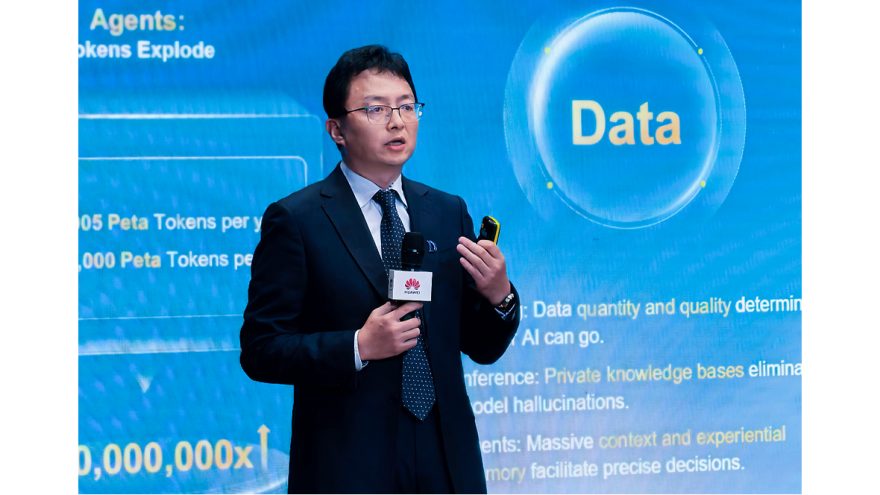
Huawei ran a data storage summit alongside HUAWEI CONNECT 2026 in Florence, and the message coming out of it was that the storage business had been reorganised around a new unit of sale: the AI Data Platform, which Huawei bills as the first 3 plus 1 solution of its kind because it combines a knowledge base, a key-value cache store, a memory bank and a Unified Cache Manager in one system.
The pitch came from Yuan Yuan, president of Huawei’s data storage product line, who argued that AI has moved past the stages of computing power, models and agents into a stage where data itself decides the outcome. Huawei says the platform runs in more than 20 service scenarios. In one hospital deployment, the platform parses and vectorises multimodal medical data and builds a knowledge graph, which Huawei says lifted the adoption rate of AI-assisted diagnosis reports from 50 percent to 90 percent. A large internet company running specification-driven coding hit a storage bottleneck on cache growth and used multi-level cache scheduling, prefix cache and intelligent suffix association to raise inference throughput 2.2 times in tokens per second. A large bank used the same platform for call analysis and recorded a 16 percent rise in customer satisfaction.
The named deployments came from outside Huawei, which is where the summit stopped being a product presentation. Daniele Cesarini, head of AI and HPC architecture at Italy’s Cineca supercomputing centre, described how Cineca adopted Huawei OceanStor Pacific scale-out storage to build an exabyte-scale scientific data lake for the Square Kilometre Array radio astronomy project, with tiered storage separating hot, warm and cold data. Marco Frontini, chief information and digital officer at Cerba HealthCare Italia, said his group runs 400 medical centres, serves more than 1.2 million patients and conducts over 50 million examinations a year, and that consolidating a legacy IT architecture spread across 50 laboratories and five central nodes onto one full-scope platform cut five-year total cost of ownership by 23 percent while adding ransomware protection. Lucio Ceruti, chief technology officer of Huawei’s data storage operation in Italy, put the engineering numbers behind the claims: FlashLink algorithms built on a separated data and control plane improve performance by 50 percent, an integrated ransomware protection system working with the network achieves 99.99 percent ransomware identification accuracy, and hardware offload of deduplication and compression combined with dynamic CPU frequency reduction lowers power consumption further.
The market context comes from Dell’Oro Group, which forecasts worldwide data center capital spending to surpass 3 trillion dollars by 2030, with high-end accelerators the largest share. Dell’Oro’s research director Baron Fung said the 2030 outlook has nearly doubled since the January 2026 forecast, on higher hyperscaler guidance, larger projected power capacity and higher commodity costs. The physical side is forecast to reach 120 billion dollars of manufacturer revenue by 2030 at a 22 percent compound annual growth rate, with nearly 200 GW of capacity added and thermal management the fastest growing segment, liquid cooling moving from an option to a precondition as racks get denser. The constraints Dell’Oro flagged are the ones a storage vendor cannot engineer around: equipment lead times, construction labour, grid interconnection and community consent, with EMEA the only region revised downward.
Supplier’s note: the hardware behind this class of deployment is where our own work sits, and the OceanStor Dorado line and the FusionServer rack it runs on are lines we quote routinely. Dorado all-flash and hybrid controllers are in stock at our European and Middle East warehouses, with the denser controller configurations quoted at 10 to 16 weeks because the SSD and controller allocation runs behind the enclosure, while the entry configurations ship in a few days from the same pool. We also hold OceanStor Dorado 3000-series spares and the compatible replacement part for retired flash modules, which matters to customers running an estate long enough to see controller generations change underneath them. On the deployment side, the consolidation Cerba HealthCare described is the shape of work our installation teams do most often, taking laboratory and central-node infrastructure onto a single platform with rack mount and cabling scope quoted as separate lines. Buyers of AI storage should also price the network between the array and the compute, and that is where we push QSFP28 and SFP28 module content alongside the storage so the ports are sized for the ingest rate the platform is sold on, not for the array capacity.