
ZTE Ships an Air and Liquid Hybrid IT POD and Puts a Number on How Fast It Reaches Site
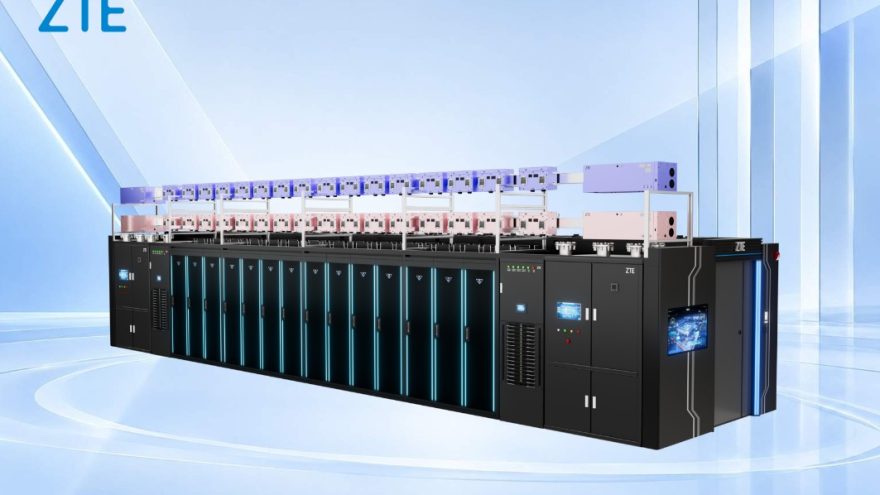
ZTE launched a new generation of its integrated IT POD solution at Data Center World Asia in Singapore, and the useful part of the announcement was a delivery figure. In 2025 ZTE won the bid for 666 IT modules for a computing centre project in the Yangtze River Delta for a leading Chinese internet enterprise, 345 sets of the M8000 IT PODs have been delivered, and the elapsed time from purchase order to site arrival was one month.
The ZXEDC M8000 Intelligent Computing Micro-Module is packaged as one system. The subsystems ZTE names run to enclosed cold aisle, liquid-cooled racks, network racks, a coldplate liquid cooling CDU, secondary-side piping, high-voltage DC distribution, intelligent busbars, a thin-sheet air wall, monitoring, lighting, cabling and fire linkage. Rack power runs from 20 to 60 kW per rack with a peak of 250 kW, and the racks are decoupled from the frame so specialised form factors can be mixed in and a site can be retrofitted to liquid cooling later. ZTE says standardised, factory-assembled components shorten delivery, with single-row racks, factory prefabrication and skid-mounted transport so the pod can be hoisted into position.
The cooling design shares air and liquid sources, pairing the CDU with thin-sheet air walls so the ratio between the two can be adjusted by season and by load, and ZTE claims a PUE as low as 1.15 with that free cooling exploited. Power runs on 800V HVDC with intelligent busbars for in-row distribution, which ZTE says reaches 98 percent power supply efficiency. The liquid side carries UL system-level leak-proof certification, covering CDU, liquid-cooled racks, servers and switches, with leak detection and automatic liquid replenishment. Unified control of air and liquid cooling with AI-based optimisation is claimed to cut cooling load factor energy use by more than 10 percent, and the iDCIM platform keeps the power and cooling chain visible end to end. One architecture absorbs 3 generations of IT hardware upgrades, which is the argument for buying the pod before the servers are finalised.
The component side of the same market carries its own warning. Dell’Oro Group measured worldwide data center IT semiconductor and component revenue for servers and storage systems up 182 percent year on year in the second quarter of 2026, with DRAM and storage drive revenue growing at a triple-digit pace and average selling prices per bit rising more than 100 percent year on year. Dell’Oro measured the data center physical infrastructure market at 14 billion dollars in 2Q 2026, up 27 percent year on year. Baron Fung, Dell’Oro’s vice president of research, said the growth was driven by higher memory and storage prices alongside continued server demand, and that agentic AI is emerging as a meaningful driver for general-purpose servers. He also said supply constraints may ultimately limit hyperscaler capital expenditure plans. For a pod vendor, that translates into a component cost line that moves faster than the build schedule.
The demand backdrop is documented by Dell’Oro Group, which forecasts worldwide data center capital spending to surpass 3 trillion dollars by 2030 with high-end accelerators taking the largest share, and puts the newly added AI-specialized cloud segment of model builders and neocloud providers on nearly 60 percent compound annual growth. Dell’Oro’s research director Baron Fung said the 2030 outlook has nearly doubled since the January 2026 forecast, on higher hyperscaler guidance, larger projections for global data center power capacity and higher commodity costs, and that the top 4 US hyperscalers alone could represent about half of global capex. On the physical layer, Dell’Oro forecasts data center physical infrastructure revenue of 120 billion dollars by 2030 at a 22 percent compound annual growth rate from 2025, with nearly 200 GW of capacity added, and has liquid cooling moving from an option to a precondition as rack density climbs. Annual net capacity additions peak in 2026 before moderating, and solid-state transformers are expected to weigh on UPS demand from 2029. The 250 kW peak rack in ZTE’s specification is the figure that separates a site needing a retrofit from a site needing a replacement.
Supplier’s note: ZTE is one of the vendors we quote for both sides of this build-out, and the pod itself is not a shelf item, so customers should expect a project cycle. The M8000 configuration ZTE describes, with CDU, 800V HVDC distribution and air wall shipped as one prefabricated unit, is quoted project by project, and we currently price a 20 kW to 60 kW single-row pod with delivery windows of 4 to 6 months from order because the mechanical and power subsystems are built to order. What we hold in stock is the content that goes inside: rack server and rack mount hardware, power supply modules and rectifier units, cooling fan trays, plus fibre patch cord and optical distribution frame material for the cabling scope ZTE bundles in. For customers running liquid cooling today we hold spare parts programme items for CDU pumps and leak detection parts on installed models, and we quote a cross-reference for controller boards inside the CDU when the original part is end of life. Our install crews have taken liquid-cooled pods into 2 customer sites in the Middle East, and the commissioning detail that consumes time in practice is the secondary-side piping and the leak detection loop, so we price that engineering day apart from the hardware line.