
Huawei’s New Data Centre Fabric and a 10 Gbps Campus Standard Both Landed in Florence
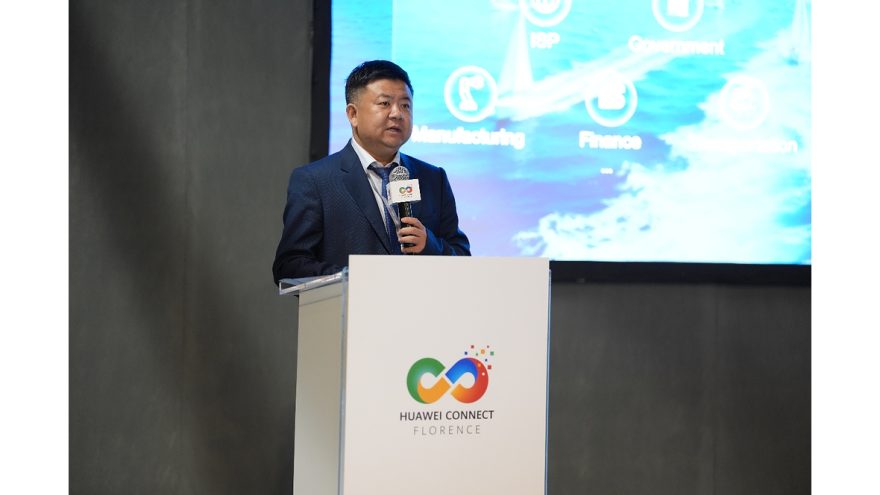
Huawei spent two days in Florence arguing about single points of failure. At its Network Summit 2026 the company put an upgraded Stellar Intelligent Fabric in front of European data centre buyers, and in a separate session released a white paper on building 10 Gbps intelligent campus networks with a group of industry bodies.
Johnny Cheng, who runs the data center network domain in Huawei’s data communication product line, described the Stellar Intelligent Ultra-Resilient Fabric as running on StarryWing Digital Map 2.0 and Rock-Solid Architecture 2.0, with the combination intended to remove single points of failure from large campus and multi-centre topologies. Around it sat a wider upgrade of the Stellar Intelligent Network, presented as “Secure and Intelligent Connectivity”, adding what Huawei calls four dimensions of computing power: efficient production, lossless scheduling, superfast application and multi-dimensional security. A three-level energy saving framework, spanning devices, networks and operations, came with it, and more than 600 people attended the summit. The customer story came from outside Huawei, because at this kind of event it usually does. Mesut ÖZCA, leader solutions manager at KoçSistem, said his company used StarryWing Digital Map to build a multi-data-centre topology where multi-plane networking gives cross-centre self-healing and keeps compute services up through localised hardware failures.
The white paper is the more interesting document for a buyer with a campus to wire. It carries signatures from Wifirst, Networld Europe and the Datacom Industry Association, and sets out six capabilities: autonomous network, 10 Gbps ultra-broadband, connected everything, deterministic experience, energy saving and full-scope security. Aldo Artigiani, technical officer of OEHI’s Interconnect Working Group, said ITU-T and OEHI have published Ethernet standards aimed at artificial intelligence and high performance computing, and pushed the industry toward open Ethernet. The matching campus solution leans on Wi-Fi 7 Advanced with multi-AP coordination, which Huawei says doubles network performance, and on a network digital map combined with NetMaster to cut mean time to repair by 90 percent.
How much of this the market is actually buying is a question IDC’s quarterly wireless LAN tracker answers with numbers that move fast. The worldwide WLAN market reached 2.7 billion dollars in the first quarter of 2026, up 15.9 percent year on year, with the dependent access point segment up 18.5 percent to 2.1 billion dollars. Wi-Fi 7 accounted for 44.5 percent of enterprise dependent access point revenue against 11.8 percent a year earlier, and its revenue of 958.4 million dollars was up 348 percent from 214.1 million dollars. Wi-Fi 6 fell to 34.8 percent and Wi-Fi 6E held 20.0 percent. IDC measured the Americas up 17.0 percent to 1.29 billion dollars, which is 48.5 percent of the total, EMEA up 15.7 percent to 799.7 million dollars, and Asia Pacific excluding China up 13.7 percent to 565.5 million dollars. Cisco held 1.0 billion dollars and 38.9 percent share, HPE Networking 527.9 million dollars and 19.9 percent, Ubiquiti 345.1 million dollars and 13.0 percent, and Huawei 158.5 million dollars and 6.0 percent, with growth of 27.7 percent driven by Wi-Fi 7 campus solutions outside North America and Western Europe.
One set of numbers from Dell’Oro Group sits awkwardly beside that optimism. The worldwide data center physical infrastructure market was 14 billion dollars in the second quarter of 2026, up 27 percent year on year, and the July 2026 five-year forecast has manufacturer revenue growing 22 percent a year from 2025 to 2030, ending at 120 billion dollars, with nearly 200 GW of capacity added. Alex Cordovil, research director at Dell’Oro, said demand is no longer the open question and delivery is, citing equipment lead times, construction labour, grid interconnection and community consent. EMEA, the region Huawei addressed with these two launches, is the only one Dell’Oro revised downward, on slower power availability and a harder permitting environment. A 250 kW rack and a 200 GW capacity addition curve are what a fabric design has to be sized against, and neither document discusses either.
Supplier’s note: we ship Huawei enterprise access switch and carrier ethernet switch lines, plus the remote radio unit and antenna range behind the campus and small cell work described here, and the supply picture on that side of the portfolio is stable enough to quote. Huawei campus Wi-Fi 7 access points and the enterprise access switch models paired with them run 8 to 12 weeks at European distribution level, with the current generation of access switches in stock and the higher density models quoted against allocation. On the data centre side we hold Stellar-class fabric and line card spares for refresh work, and the multi-plane topology KoçSistem described is something our own installation teams have built for customers running compute across two buildings, where the cross-centre self-healing behaviour matters more than headline port counts. For procurement teams weighing a standard that only four or five vendors will implement, the honest comparison point is that a 10 Gbps campus refresh also needs power and cabling work priced separately, and we quote those as separate line items so a customer is not surprised by the ceiling work. We do not yet quote first-generation Wi-Fi 8 hardware, and we say so plainly to customers instead of substituting current Wi-Fi 7 stock and calling it a roadmap.